Hybrid Recall for Agent Memory
Keyword and vector search over the same facts, merged by rank, on one Durable Object.
An agent that remembers things about its owner has a retrieval problem that most search tutorials do not cover. The memories are short. “The owner prefers metric units.” “The staging site lives at this address.” Each one is a sentence, and the questions asked of them are shorter still: “Who is Priya?”
Embedding models are weak at this. Short sentences that share a template (“X’s brother is Y”, “X’s sister is Z”) land close together in vector space, so the right fact can sit at rank three or five behind its look-alikes. Keyword search has the opposite profile: it finds a name exactly and has no idea that “wife” and “spouse” mean the same thing.
This post describes the memory design I moved to: both searches over the same facts, merged by rank.
Requirements
- Short facts as the unit. Not documents, not chunks.
- Find a fact by a name, and also by a paraphrase.
- No duplicates. An agent will state the same fact many times.
- One place for the data, with writes that cannot race.
- Runs on Cloudflare with no external database.
Architecture
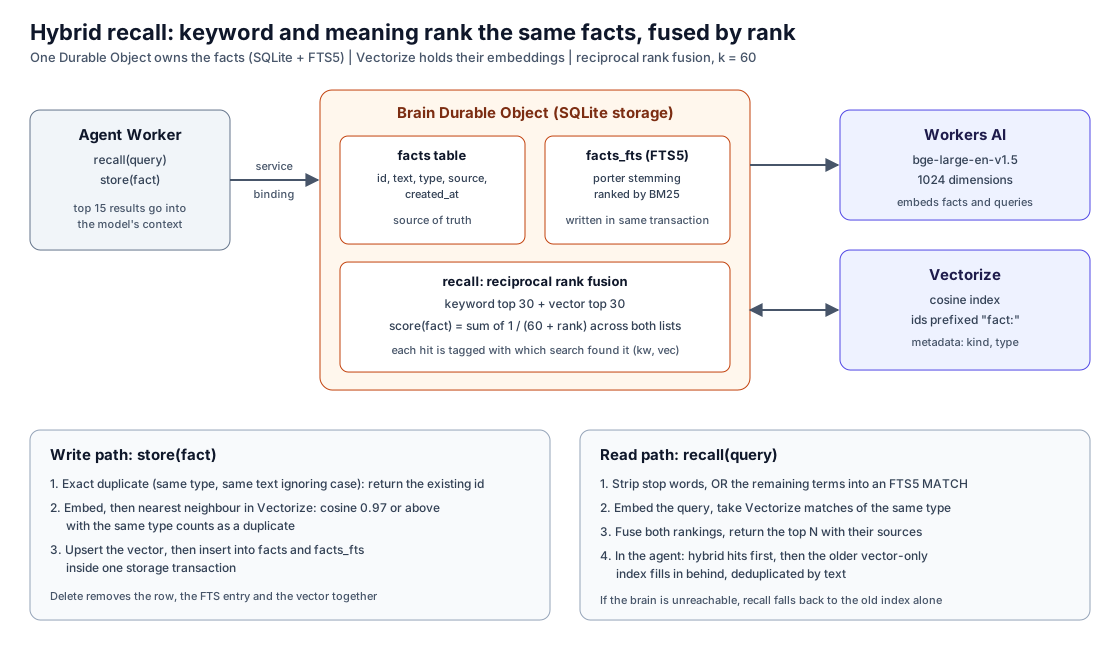
A single Durable Object holds the whole memory. At this scale (tens of facts, about a hundred long-form pages) that is not a scaling decision. It buys strict serialisation, so a background job and an interactive write can never interleave.
Storage uses the Durable Object’s SQLite database:
- A
factstable holds the text, a type (fact,skillorlog), a source and a timestamp. It is the source of truth. - A
facts_ftstable is an FTS5 index over the same text, with Porter stemming, ranked by BM25. - Vectorize holds one embedding per fact, from Workers AI
bge-large-en-v1.5(1024 dimensions, cosine). Vector ids are prefixedfact:so facts and long-form page chunks can share an index.
Durable Object SQLite supports FTS5, but not triggers and not explicit BEGIN statements. The index is therefore kept in sync in code, and the two inserts run inside transactionSync.
The agent reaches the memory over a service binding with a shared-secret header, not over a public URL.
Recall by rank fusion
Recall runs both searches and merges them with reciprocal rank fusion:
- Remove stop words from the query and join the remaining terms with
ORinto an FTS5MATCH. Take the top 30 by BM25. - Embed the query and take the top 30 Vectorize matches of the same type.
- Score every fact as the sum of
1 / (60 + rank)across the lists it appears in. Sort and return the top N.
Rank fusion needs no score calibration. BM25 scores and cosine similarities are on unrelated scales, and fusing by rank sidesteps the problem. A fact that either search ranks highly will surface, and a fact that both rank well rises to the top. Each result carries a via tag (kw, vec or both), which makes a bad recall easy to debug.
Writes that deduplicate
An agent writes the same fact repeatedly, in slightly different words. Two checks run before a fact is stored:
- Exact: the same type and the same text, ignoring case.
- Near: the nearest neighbour in Vectorize has the same type and a cosine score of 0.97 or above.
Either one returns the existing id instead of inserting. Deletion removes the row, the FTS entry and the vector together.
Results
I measured it on the memory I actually had: 48 facts and 24 questions written the way the agent asks them (“What units does the owner prefer?”, “When is the renewal due?”). I compared the previous vector-only recall with hybrid recall.
| Correct fact in top 5 | Correct fact at rank 1 | |
|---|---|---|
| Vector only | 22 of 24 | 20 of 24 |
| Hybrid | 24 of 24 | 15 of 24 |
Hybrid recall found every fact. Two hits were rescues: vector-only missed the top 5 entirely on a bare first name and on a question about a person’s role. Hybrid found both (at rank 1 and rank 3). It also moved two bare-name queries from rank 3 up to rank 1.
It also ranked the right fact first less often on questions that share a template: 8 of the 24 landed at rank 2, nearly all of them relationship questions, and one landed at rank 3. I have not isolated the cause. My working explanation is that fusion lifts look-alike facts that share query terms, but I did not test it. The agent does not use a single top result. It injects the top 15 into the model’s context, so being found matters more than being first, and that is why this trade is acceptable here. A system that shows only the first result should not take it without tuning.
The sample is small. Treat the numbers as evidence that the approach works on short personal facts, not as a benchmark.
Design principles
- Match the retrieval to the data. Short, templated sentences are where embeddings are weakest, and where keyword search is strongest.
- Fuse ranks, not scores. It removes the need to compare unrelated scales.
- Deduplicate on write. A memory that grows with every repeated statement gets worse to search.
- Keep the old path as a fallback. In the agent, hybrid hits come first, the older vector index fills in behind, and the results are deduplicated by text. If the memory Worker is unreachable, recall behaves as before.
What this does not claim
- It is not a benchmark. Forty-eight facts and twenty-four questions show direction, not scale.
- It has not been tested at tens of thousands of facts. One Durable Object holding everything is a deliberate choice for a personal-scale memory and would need sharding beyond it.
- The fusion constant (60) and the 0.97 duplicate threshold are the common defaults and my first choices. I did not tune them.
- Rank 1 accuracy got worse, as the table shows.
References
For agents
Summary: A reference design for agent long-term memory on Cloudflare: short facts stored in a SQLite-backed Durable Object with an FTS5 keyword index, embedded with Workers AI into Vectorize, and recalled by merging the keyword and vector rankings with reciprocal rank fusion.
Prerequisites
- A Cloudflare account with Workers, Durable Objects (SQLite-backed), Vectorize and Workers AI
- wrangler
- A Vectorize index with 1024 dimensions and cosine metric
Steps
- Create the index: npx wrangler vectorize create gbrain-chunks --dimensions=1024 --metric=cosine
- Declare a Durable Object with a SQLite migration (new_sqlite_classes), a Vectorize binding and a Workers AI binding
- Create a facts table and an FTS5 table with the porter unicode61 tokenizer; keep the FTS table in sync in code inside a transaction, not with triggers
- On write: reject exact duplicates, then reject near duplicates (cosine 0.97 or above, same type) found in Vectorize, then upsert the vector with id fact:<uuid> and insert the row and FTS entry in one transaction
- On recall: build an FTS5 MATCH from the query terms with stop words removed and joined by OR; embed the query and query Vectorize; take the top 30 of each; score each fact as the sum of 1/(60+rank) across both lists; return the top N
- Expose the Durable Object to other Workers through a service binding with a shared-secret header
Diagrams, in words
- Left to right: an Agent Worker calls a Brain Durable Object over a service binding. Inside the Durable Object are a facts table, an FTS5 keyword index, and the recall step that fuses the two rankings. To the right, Workers AI (bge-large-en-v1.5, 1024 dimensions) embeds text and Vectorize stores the vectors. Below, two panels describe the write path (duplicate checks, embed, transactional insert) and the read path (keyword search, vector search, rank fusion, then the agent merges with its older index).
Descriptions reflect the author's own deployments using generally available services and public documentation.
This post contains no credentials. Do not put tokens, API keys, service-token secrets or one-time codes into prompts or commits; use environment variables or secret stores.